Email Provider Fallbacks Are a Product Decision
A practical guide to choosing fallback routes for transactional email without silently dropping message fields.
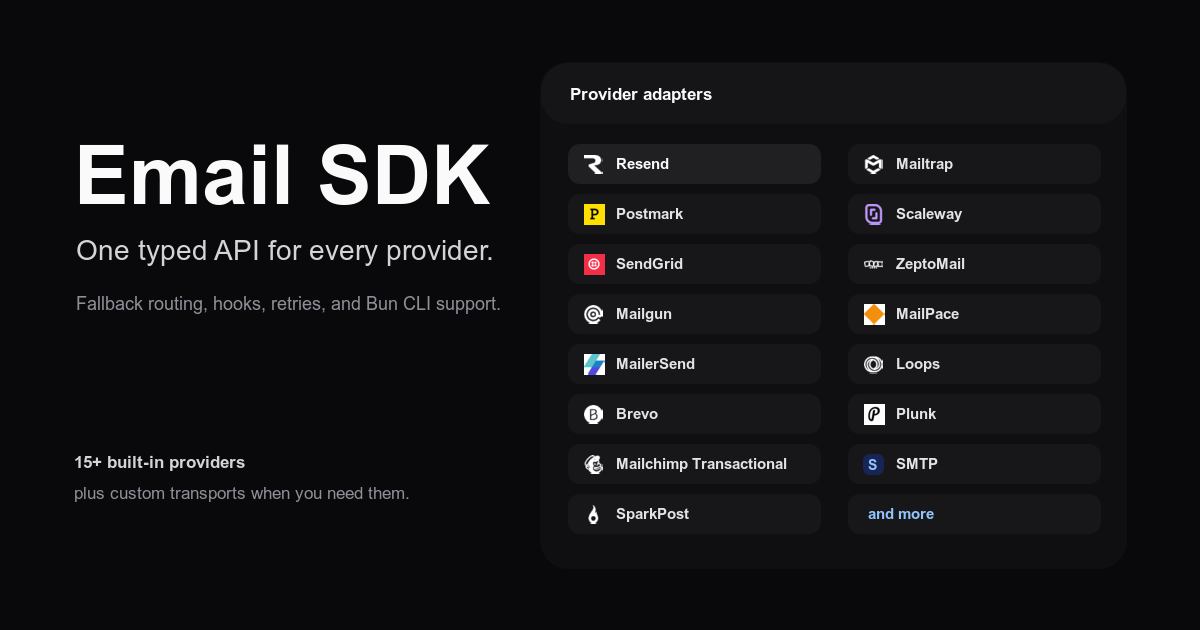
A fallback route is not a magic second chance. It is a product decision. If the backup provider cannot send the same message, the fallback can turn a provider outage into a quieter bug: the email leaves your app, but the data you meant to send does not.
That is why Email SDK treats adapter limits as part of the API. Providers do not agree on tags, metadata, attachments, headers, reply-to behavior, or batch semantics. A good email layer should admit that instead of smoothing it over.
Start with the email, not the provider
Before picking a backup provider, sort emails by what they need to carry. Password resets and login codes are usually plain. Receipts often need headers, attachments, or metadata. Product notifications sit somewhere in the middle.
| Email type | Usually needs | Fallback posture |
|---|---|---|
| Login code | Plain text or simple HTML | Good candidate for a broad fallback route. |
| Receipt | Headers, metadata, maybe attachments | Use a provider with equivalent field support. |
| Product digest | Template data, tags, unsubscribe behavior | Fallback only after checking provider-specific behavior. |
| Audit or compliance email | Stable IDs, metadata, traceability | Be conservative. Dropped metadata is not harmless. |
A small fallback checklist
- Does the backup adapter support every field this email uses?
- Will the sender identity work from the same domain?
- Do you need a different from address, reply-to address, or region?
- Can your logs tell which provider actually sent the message?
- Does retrying risk duplicate emails, or is the send idempotent enough?
The boring answer is usually the right one: use fallbacks for simple, time-sensitive transactional email first. Then add stricter routes for messages that carry richer data.
const email = createEmailClient({
  adapters: [
    resend({ apiKey: process.env.RESEND_API_KEY! }),
    postmark({ serverToken: process.env.POSTMARK_SERVER_TOKEN! }),
  ],
  defaultAdapter: "resend",
  fallback: ["postmark"],
  retry: { retries: 1 },
});
Why fail-fast beats silent fallback
Silent fallback feels friendly until something important disappears. If a provider cannot represent metadata, attachments, or custom headers, Email SDK should stop before the request. That failure is annoying, but it is visible. Visible is fixable.
The alternative is worse: a message goes out, dashboards look green, and three weeks later somebody asks why customer receipts stopped carrying the IDs your support team relies on.